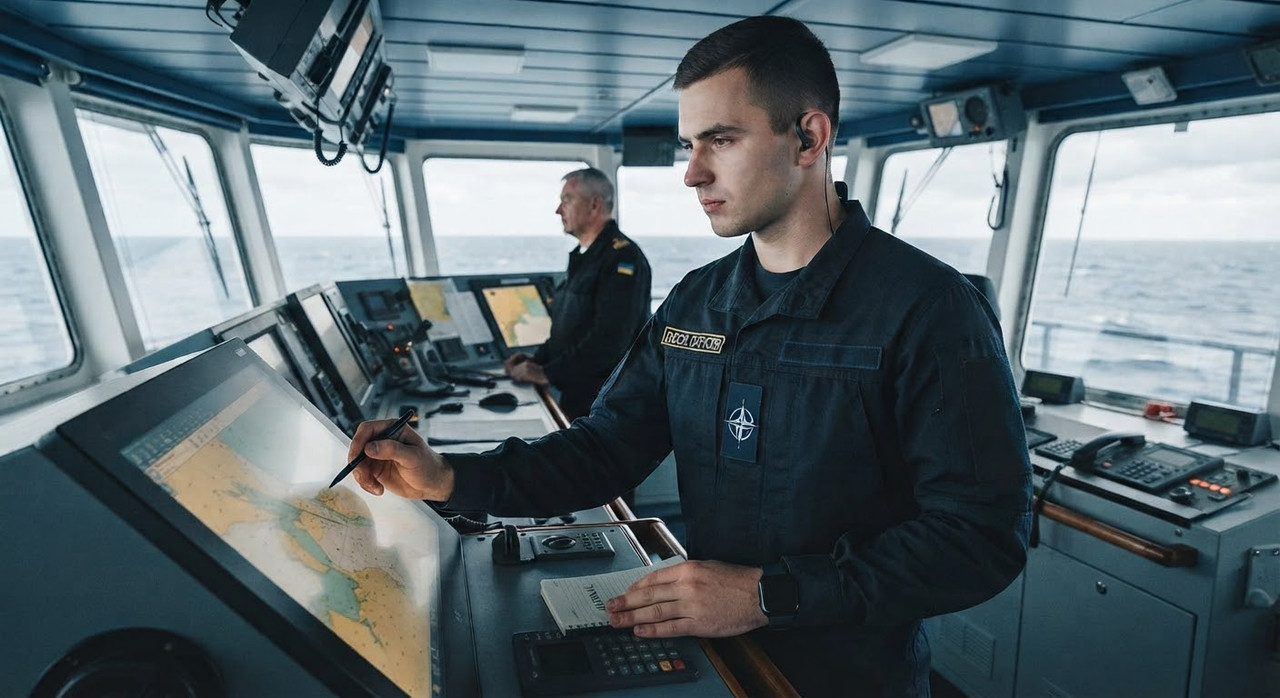
There's something the academy doesn't tell you straight, and should, in the first year.
The diploma is not the problem. Everyone who sits it out will get one. The problem starts on the way out, when it turns out that nobody needs you without sea time, and sea time only comes from a voyage you can't get onto — because you have no sea time. The circle closes, and every year part of the graduating class gets stuck inside it. Not the least capable ones. The ones least prepared for this particular moment.
Let's take apart how people get out of it. No stories about believing in yourself.
Why taking a cadet is a bad deal, and what follows from that
Start with the unpleasant part, because understanding it changes the whole strategy.
To a shipowner, a cadet is a cost. A bunk is occupied, food is served, insurance is paid, and you do less work than a rating. On top of that somebody has to deal with you: sign the book, be pulled off their own job to teach. There is no commercial reason to take a cadet — there are convention requirements, obligations to academies, and reputation.
Which gives you the thing to accept and work with: you are taken not because you are good, but because the company has a reason to take a cadet. Your job is to be where that reason exists, and not to get in the way of it.
That changes how you search. Spraying your CV across every crewing agency is close to useless: most of them have no reason to take a cadet at all. You search narrowly — where a cadet programme exists as a programme.
Three roads, honestly
Through the academy. The most reliable and the most underrated. Maritime schools have agreements with companies, and berths are handed out through the department constantly. The catch is that they are not handed out at random: they go to whoever came earlier, was visible, has no outstanding exams and is recognised by the staff.
If you are in your second or third year and reading this — here is the main advice in the article. Go to the department now, not after your defence. Ask which companies take cadets, what they require, who handles placement. By graduation you should be the person who comes to mind when a request for two cadets arrives.
If the academy is already behind you, don't write this route off. Nobody closed the department, and a graduate who walks in and asks politely is still a rare thing.
Straight to a crewing agency. It works, but it needs patience and the right target. Don't write "looking for any position" — you're filtered out in the first second. Write to the ones whose vacancies have ever carried Deck Cadet or Engine Cadet: that means a programme exists.
After that the mechanics are simple and slow: an application, then reminding them you exist. Not daily — monthly, short, without desperation. Cadet berths appear in waves tied to crew rotations, and it isn't the most persistent who wins but the one whose application happened to be in front of someone in the right week. Your goal is to be alive rather than forgotten in that week.
At your own expense. It exists, and I won't pretend otherwise — plenty of people get in this way. The company takes a cadet, but you cover the flight, the paperwork, sometimes part of the costs. That is lawful and it is not a scam.
But a line runs through here, and past it the scam begins. You need to see that line clearly.
Where common practice ends and the scam starts
Paying for a visa, a flight and document processing — happens. Unwelcome, arguable, but it happens at real companies, especially with cadets.
Paying for the job itself — never. A crewing agency earns from the shipowner, not from the seafarer. If you are asked for money "for the place", "for reviewing your application", "to guarantee the contract" — that is not a crewing agency. However good the office looks and however long the firm has existed.
A simple test that works nearly every time: ask them to show you where that sum is written in the contract, and ask what happens to the money if the voyage falls through through no fault of yours. A real company answers calmly, on paper. A con artist starts explaining that "everyone does it now" and that the place will go to someone else if you keep stalling. Pressure by deadline is the main marker.
The second marker: the money is wanted in cash or to a private card. That's the end of the conversation.
What you need before anyone will talk to you
Short, because the list is finite and known.
Basic convention courses, a valid medical, a seaman's book, a passport with a sensible amount of validity left. This is not an advantage — it is the condition of entry. Someone without the full set is not considered at all: an agency has no time to wait while you finish collecting.
Separately, on English. The level deserves its own article, but for a cadet it comes to this: nobody will test your grammar. They will test whether you understand an order and can say what you see. The one who answers with an embarrassed silence gets filtered out — not because his English is poor, but because on the bridge, silence is more dangerous than a mistake.
And the photograph on your application. A small thing nobody mentions: a selfie in a car or a shot from graduation counts against you. You want a plain portrait, face visible, quiet background. This isn't social media. You are applying for work in which tidiness is part of the trade.
If you are Ukrainian
Here I have to say the thing articles usually avoid.
Leaving the country. For men this is currently the central question, and it matters more than which company you pick. The rules have changed more than once, and any article that gives you a specific procedure risks being out of date by the time you read it. So, honestly: establish the current procedure before you start looking for a contract, not after you sign one. The source is not a forum or a chat — it is official guidance and your crewing agency, which deals with this every day.
The order that keeps you out of trouble: first understand on what terms you can physically join a ship, then look for the contract. The other way round risks committing to something you cannot deliver, and starting your career with a reputation problem.
Academies. Some institutions have changed address, some operate in an altered form. If you studied before the move, check where to go now for documents and placement. Departmental links with companies have mostly survived; they've simply become less visible from the outside.
One advantage people forget. To a shipowner, a Ukrainian cadet is a known quantity. There are many, the standard of training is understood, the documents are readable. It's not an advantage over a Polish colleague on paperwork, but it isn't an exotic case that needs explaining either. That is a normal starting position.
If you are Polish
Your situation is materially different, and it would be a waste not to use it.
EU documents. Your passport removes half the friction that slows a Ukrainian colleague down: visas, permits, processing time. For a company that is less work, and less work is a real argument when everything else is equal.
The home market. Gdynia and Szczecin are not only schools but a live market around them: ferries, tugs, Baltic offshore, vessels serving wind farms. A first contract does not have to be ocean-going. Coastal trade and short sea give you exactly the same sea time, and are noticeably easier to get into.
Wind farms. Baltic offshore wind deserves its own mention — the sector is growing, it needs people, and it is less obvious to a graduate than the classic merchant fleet. A shorter queue.
What not to do. Don't fixate on big names. A mid-sized ferry operator will give you a first contract faster than six months of waiting on a giant, and in sea-time terms those are the same months.
What to accept and what not to
Worth accepting: an inconvenient vessel type, an unglamorous trade, a short contract, a company you've never heard of but can verify. On a first contract you are not buying money or a line on your CV — you are buying months of sea time. Everything else comes later.
Not worth accepting: verbal arrangements. Anything promised out loud — a bonus, an extension, a move to another rank — does not exist. Only what is in the contract exists. Cadets are often shy about asking for the document in advance, and that is a mistake: a normal company gives you the contract before the flight and does not take offence at questions.
Separately: do not accept a contract you were not allowed to read. Not "didn't get around to it" — actively not given. This is not about cadets or about being difficult. It's about the fact that an honest company has nothing to hide.
How long it actually takes
From starting the search to a first contract, for a graduate with no connections, is usually somewhere between a few months and a year. Not because you're bad, but because cadet berths appear in waves and you have to land in one.
The practical conclusion: don't wait, search in parallel. Department, agencies, listings — at the same time, not one after another. And keep a list: where you wrote, when, what came back. In three months you won't remember, and a second email to the same company a week after a refusal looks bad.
One last thing
The most common mistake a graduate makes is treating a refusal as a verdict on himself. It isn't one. Nine times out of ten it means there are no berths right now, not that you aren't good enough.
The people who end up at sea differ from the ones who didn't, not in talent. They simply didn't stop writing in the fourth month.
Good luck with the first one.
Current vacancies, cadet berths included, are in the vacancies section. Alerts for your rank arrive on Telegram as soon as something matching is posted.