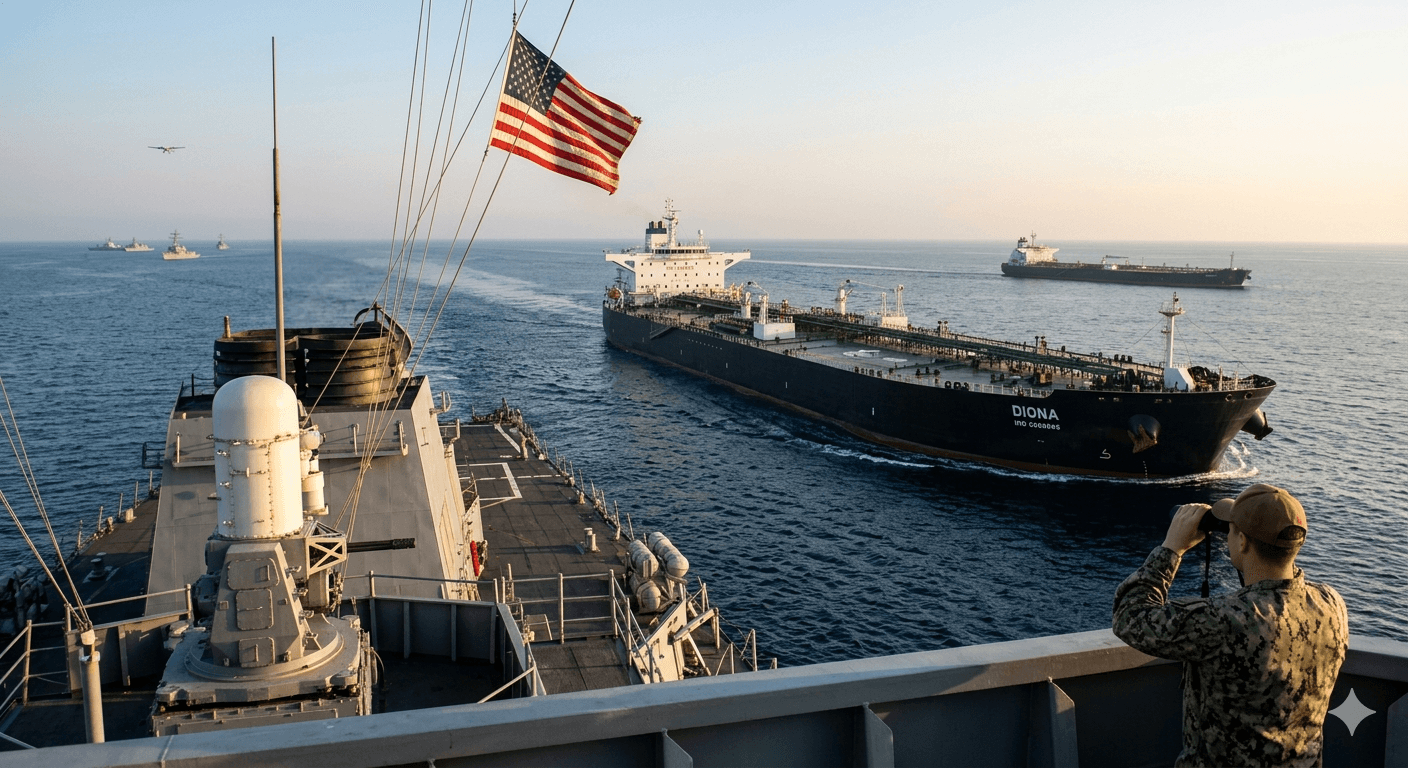
Iran Tests the Waters: First Tankers Breach US Blockade Line Amid Signals of Loosening Tension
17 June 2026
After a months-long standoff, there are signs that the naval blockade around Iran may be easing, with the first Iranian tankers observed breaching the line to export crude oil. The consulting firm TankerTrackers.com, which has been meticulously logging the movement, noted that while a small number of empty "shadow fleet" tankers had been sneaking into Iranian waters for weeks to provide floating storage, a dynamic shift occurred this week.
US Central Command has officially maintained that the blockade is in effect until June 19th. However, two Iranian-owned Very Large Crude Carriers (VLCCs), the Diona (IMO 9569695) and the Hero2 (IMO 9362073), both owned by NITC, turned on their AIS transponders on Tuesday and made the unprecedented outbound run. They were followed shortly by a Suezmax tanker, the Sonia I (IMO 9357365), also an NITC vessel, as confirmed by Pole Star Global. These moves are the definitive signals of a change in posture.
"These are Iran's first crude oil exports in two months," TankerTrackers.com reported. This analysis was reinforced by tracking firm Kpler, which identified a total of four Iran-linked tankers exiting the Gulf of Oman, signaling a potent motivation for Iran to clear its stored inventory.
This movement is the strongest evidence to date that the extreme navigational restrictions in the strait are being relaxed, likely tied to a recently signed Memorandum of Understanding (MOU). This relaxation is not a complete de-escalation, however. Reports suggest that Iranian forces have continued to launch small-scale drone attacks at ships in the Strait of Hormuz since the MOU was signed. Central Command's Joint Maritime Information Center (JMIC) maintains that a "substantial" risk to navigation persists in the area.
Despite the remaining risks, the market is bracing for a rush. A massive amount of global tanker tonnage is currently converging on the region, positioning itself to seize the moment when the Strait of Hormuz formally reopens. Goldman Sachs estimates that over 800 million barrels of tanker capacity—representing a substantial portion of the global fleet—is within five days' sailing distance of the strait.
The maritime intelligence firm Windward noted, "VLCCs signaling the UAE as their next destination are tracked sailing from as far as the South China Sea and across the Indian Ocean." According to their data, "At least 23 VLCCs are currently heading for the UAE ports of Khor Fakkan or Fujairah... joining at least 30 already at anchorage there."
The critical bottleneck remains war risk insurance cover, as is standard in conflict zones. The Trump administration is reportedly encouraging insurers to provide viable commercial cover and has even considered implementing a "VIP pass" system. This novel concept would include a "pay-for" element, potentially providing commercial shipowners with the security benefit of US Navy escorts, which has not previously been available.
For now, caution prevails among the largest fleet owners. "Most shipowners appear to be cautiously awaiting more details before planning new transits," Niels Rasmussen, chief analyst at BIMCO, told CNBC. "They will seek reassurance that transits are not only permitted but also safe before sending their ships through the strait."
Jobs by rank
Jobs by vessel type
Jobs by country
Comments
Be the first to comment