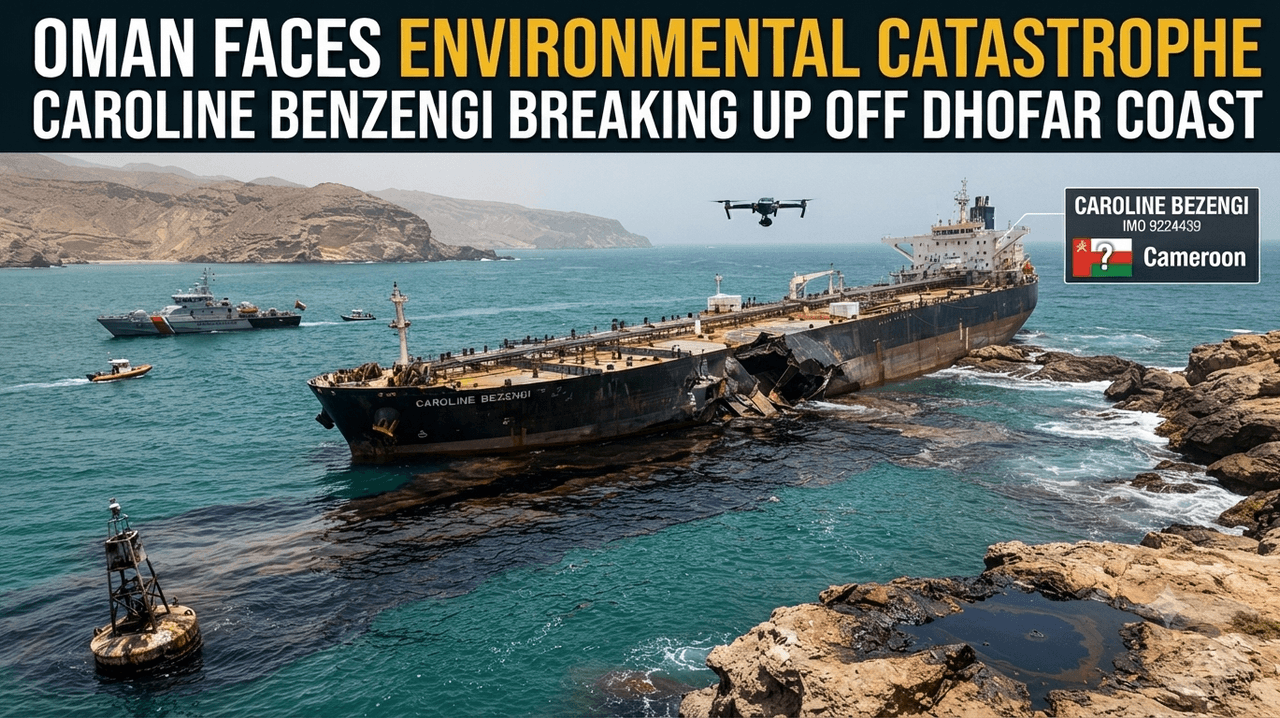
Oman Faces Environmental Crisis as Grounded Tanker Threatens Dhofar Coast
22 July 2026
Oman is currently confronting a severe environmental threat as the Caroline Bezengi (IMO 9224439)—a Supermax tanker belonging to the Russian dark fleet—begins to break apart after running aground on the rocks of Jazirat Al Qibliyyah, one of the Hallaniyat Islands in southwest Dhofar.
Incident Timeline and Vessel Background
June 8: The crew reported an explosion onboard while the vessel was off the coast of Dhofar, with Reuters later reviewing video footage that appeared to show active leaks.
Vessel Specifications: Built in 2001, the 274-meter (899-foot) ship has a capacity of 159,168 deadweight tons (dwt).
Registry Status: Although it has operated under the name Caroline Bezengi since 2023 reporting a Cameroon flag, this registry is believed to be false. The vessel was removed from Cameroon's registry in June as part of an international crackdown on sanctioned tankers.
Sanctions and Route: The ship is sanctioned by the EU, UK, and the US (OFAC), has previous links to Russian state-owned shipowner Sovcomflot, and was traveling from Novorossiysk to India with a full cargo load.
Current Condition and Structural Risks
Following the incident, the crew seemingly abandoned the ship after roughly three days, though some post-evacuation officers have assisted Omani authorities with assessments.
An onboard survey conducted by Omani maritime authorities on July 12 revealed alarming structural deterioration compared to an aerial survey a week prior:
Nearly all cargo tanks are fully laden and showing signs of seawater contamination, with only a single empty tank remaining unbreached.
The tanker is sinking deeper into the water with an increasing list, heavily exposed to rough seas typical of the current monsoon season and surrounding rocks.
Crude oil has leaked into the ballast and double-hull spaces, creating potentially explosive fumes.
Salvage Challenges and Environmental Stakes
Omani authorities have faced communication hurdles with the registered single-ship owner and manager, Shanghai-based Rentoor Shipmanagement, whose authorization is typically required before salvage operations can begin. In response, Oman commissioned an independent evaluation from a leading salvage firm.
The evaluation confirmed the vessel's hazardous condition but outlined a viable salvage plan: offloading the cargo via a 1,000-yard pipeline to a receiving tanker anchored in safer waters, followed by refloating the lightened ship. However, experts warn of high risks regarding potential explosions and further structural break-up during the process.
Without immediate authorization and salvage intervention, officials warn that the Caroline Bezengi could fracture completely and spill its cargo. Such a disaster would devastate the strictly protected Hallaniyat Islands Marine Buffer Zone—home to vulnerable populations of humpback whales, seabirds, and turtles—while heavily contaminating wide stretches of the Dhofar coastline.
Jobs by rank
Jobs by vessel type
Jobs by country
Comments
Be the first to comment