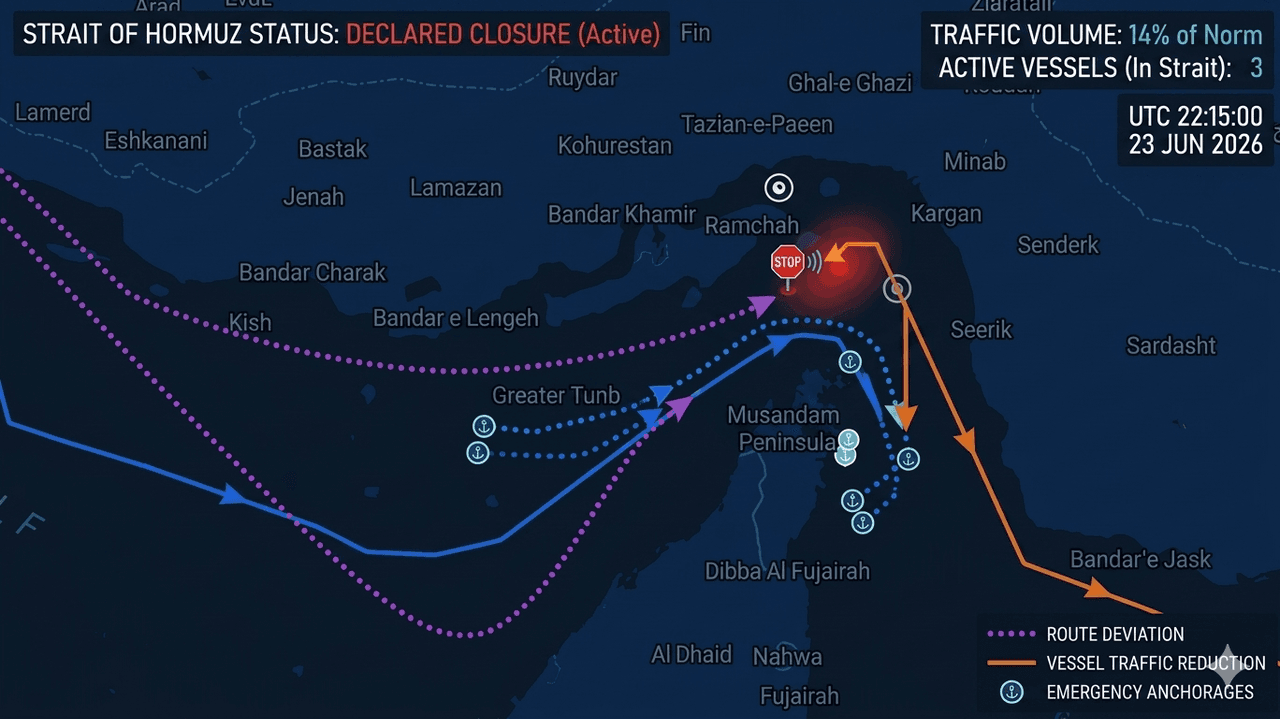
The Strait of Hormuz is Closed Again: Reality vs. US Claims and the Price of the Lebanon Question
22 June 2026
We are once again witnessing a dangerous escalation in one of the world's most critical transport arteries. The Strait of Hormuz, which seemed safe only yesterday, has fallen silent today. Iran has apparently carried out its threat and re-closed the passage, linking this move to Israeli actions in Lebanon. This isn't just economic news; it's a high-stakes geopolitical game, and early data shows that global shipowners have taken it seriously.
I have analyzed the latest reports from marine monitoring systems. Analysts at Windward, for instance, recorded just 12 transits through the strait on June 21. Think about that number: it's nearly half the 21 ships that transited just the day before, prior to Tehran's official statement. Of those 12, most are Iranian tankers or sanctioned vessels, many operating with their AIS transponders turned off. This does not look like an international trade route. It looks like a blockade zone.
The most surprising element here is the disconnect between reality on the water and the official US position. Yesterday, CENTCOM released an update claiming that traffic in the strait had increased, with 55 cargo ships transiting safely. I don't know how they were counting, or what tonnage they included—perhaps they were counting coastal dhows, which have no impact on the global oil market. But MarineTraffic satellite data shows the opposite: ships already en route were performing U-turns as soon as the news broke. The picture CENTCOM paints simply does not align with what civilian traffic tracking systems are seeing.
Now, to the core of the issue. Tehran has linked the status of the strait to the situation in Lebanon. The draft Memorandum of Understanding (MOU) with Washington includes a clause on the "permanent termination of the war on all fronts." Since Israel is not a party to this memorandum and continues to attack Hezbollah positions in Lebanon, Iran views this as a breach of the deal. This is a master geopolitical stroke. Tehran has shifted responsibility for Israel's actions onto Washington, forcing the White House to apply pressure on Jerusalem.
We are seeing the White House criticize the Netanyahu government. Even President Trump has spoken out, condemning the duration of the conflict and the number of casualties, a rare critique for him. This proves that pressure on Israel is mounting, as the White House fears a complete closure of the strait and escalation across the Middle East.
Meanwhile, in Switzerland, negotiations are proceeding with difficulty. Even without public photo opportunities and press conferences, the atmosphere is tense. Trump's threats to "hit Iran harder than last week" and sharp remarks directed at the Iranian delegation only worsen the situation. The Director of the Center for Arab and Islamic Studies of the Islamic Republic of Iran stated that negotiations will be halted if the conditions of the first article of the memorandum are not met.
Despite rumors of a breakdown, talks continue, now with Pakistani and Qatari mediators. We are observing a dangerous stalemate. Iran has closed the strait, shipowners are complying, the US is denying the obvious, and Israel is continuing the fight. And until Lebanon is calm, Hormuz will remain a hostage in this complex geopolitical game, where one false move could lead to catastrophe.
Jobs by rank
Jobs by vessel type
Jobs by country
Comments
Be the first to comment